Latest News

Why Hospitality Leaders Are Rethinking Their HVAC Filter Programs

Why Hospitality Leaders Are Rethinking Their HVAC Filter Programs

In hospitality, every detail matters.

Guests notice comfortable temperatures, clean indoor air, quiet spaces, and consistent airflow — even if they never think about the HVAC system making it all possible.

Behind the scenes, however, engineering and facilities teams face a growing challenge: delivering exceptional guest comfort while controlling operating costs and supporting corporate sustainability goals.

As labor costs rise, budgets tighten, and ESG initiatives become more important, many hotels, resorts, casinos, and entertainment venues are beginning to ask an important question:

Is our disposable HVAC filter program still the best long-term solution?

Increasingly, the answer is no.

Guest Comfort Starts Behind the Scenes

Every guest experience depends on building performance.

An HVAC system that delivers consistent airflow helps maintain comfortable guest rooms, inviting lobbies, productive conference spaces, and enjoyable restaurants and entertainment venues.

When filtration restricts airflow or requires frequent replacement, facility teams spend more time reacting to maintenance needs instead of focusing on the overall performance of the property.

Reliable filtration supports consistent HVAC operation, helping properties maintain the indoor environments guests expect throughout their stay.

Hospitality Has Already Proven That Reusable Solutions Work

Not long ago, nearly every hotel bathroom looked the same.

Rows of single-use shampoo bottles, tiny conditioner bottles, miniature soaps, and individually packaged toiletries were considered standard. Every guest room turnover meant replacing partially used products, generating enormous amounts of plastic waste while creating additional labor for housekeeping teams.

Today, that standard has changed.

Walk into almost any major hotel brand, and you’ll find wall-mounted dispensers filled with shampoo, conditioner, body wash, and hand soap. Those refillable containers have become commonplace across the hospitality industry.

The change wasn’t driven by sustainability alone.

Hotels quickly realized they could reduce purchasing costs, minimize plastic waste, simplify housekeeping operations, decrease inventory management, and maintain a consistent guest experience — all at the same time.

What was once viewed as a small operational change became a large-scale industry transformation.

More importantly, it changed how hospitality leaders think about recurring consumables.

Instead of asking, “What does this item cost to buy?” operators began asking, “Is there a smarter, more sustainable way to manage this over the long term?”

That mindset is now expanding beyond guest amenities.

Forward-thinking hospitality organizations are evaluating every recurring product throughout their facilities to determine where similar improvements can be made.

HVAC Filtration Is Becoming the Next Opportunity

Disposable HVAC filters follow a remarkably similar pattern to the toiletries hospitality has already moved away from.

Facilities purchase them.
Install them.
Remove them.
Throw them away.
Then purchase them all over again.

The cycle repeats several times every year, creating ongoing purchasing costs, maintenance labor, transportation, inventory requirements, and landfill waste.

Just as refillable amenity dispensers replaced millions of single-use plastic bottles, washable HVAC filters replace the constant cycle of disposable filtration.

Rather than throwing filters away every few months, engineering teams simply clean them, reinstall them, and return them to service.

It’s the same operational philosophy hospitality has already embraced throughout guest rooms — reduce waste, simplify operations, and maximize the value of assets already in use.

For many hotels, resorts, and casinos, reusable filtration is becoming the next logical step in that journey.

The Hidden Cost of Disposable Filters

Most hospitality operators know the purchase price of a filter.

Fewer know the true cost of replacing hundreds or even thousands of filters across a property every year.

Each replacement requires:

Sustainability Is Becoming Part of the Guest Experience

Today’s travelers increasingly value businesses that demonstrate environmental responsibility.

Many hotel brands have established ambitious sustainability goals focused on reducing waste, lowering energy consumption, and minimizing environmental impact.

Guests may not see a property’s HVAC system, but they increasingly recognize the choices hotels make to reduce waste — from refillable toiletries and water conservation programs to recycling initiatives and energy-efficient buildings.

Behind-the-scenes infrastructure improvements are becoming just as important as guest-facing sustainability efforts.

Washable, reusable HVAC filters help hospitality organizations extend those planned maintenance schedules.

The result is a simpler, more sustainable filtration program that reduces recurring purchasing and waste while helping engineering teams operate more efficiently.

A Long-Term Investment in Operational Excellence

Hospitality leaders are increasingly evaluating building systems based on total lifecycle value rather than initial purchase price alone.

Questions now include:

  • Can we reduce recurring maintenance costs?
  • How can we minimize landfill waste?
  • Are there opportunities to improve HVAC efficiency?
  • Can we simplify maintenance without sacrificing guest comfort?
  • How can our facilities contribute to our company’s sustainability goals?

These conversations are reshaping how hospitality organizations approach building operations.

The Future of Hospitality Filtration

The hospitality industry’s transition from single-use toiletries to refillable dispensers demonstrates something much bigger than a sustainability initiative; it reflects a new way of thinking.

When a product is used repeatedly throughout a property’s lifecycle, operators increasingly ask whether it needs to be disposable at all.

That same question is now being applied to HVAC filtration.

Exceptional hospitality isn’t created only in guestrooms or restaurants.

It begins with the systems operating behind the scenes every day.

As hotels, resorts, casinos, and entertainment venues continue investing in operational efficiency and sustainability, HVAC filtration is becoming another opportunity to reduce waste, lower operating costs, and improve long-term building performance.

At K&N Global Filtration, we believe reusable HVAC filters represent the next evolution in hospitality filtration, much like refillable amenity dispensers redefined guest room sustainability.

Sometimes the most meaningful improvements are the ones guests never see, but every property benefits from.

Ready to Act?

Rethink Your Filtration Strategy

Contact K&N Global Filtration to learn how washable, reusable HVAC filters can help reduce waste, improve operational efficiency, and support your property’s sustainability goals.

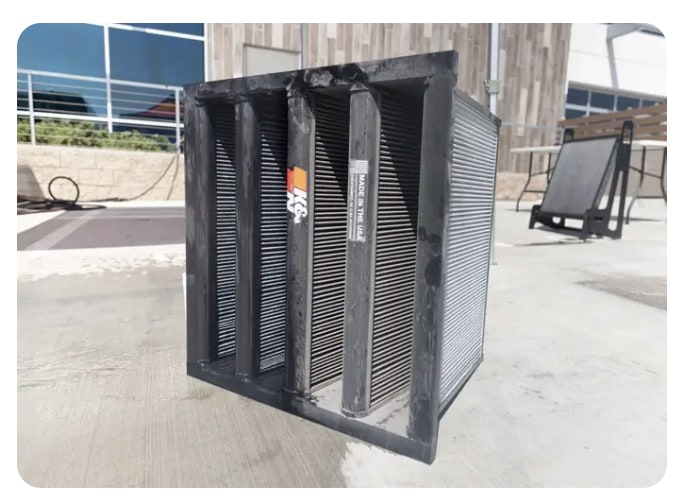
K&N Washable/Reusable V-Bank Filter Washing Instructions

K&N Washable/Reusable V-Bank Filter Washing Instructions

Maintain peak performance and extend the life of your K&N Washable Filters by following the steps below. This procedure is designed for safe, effective cleaning using only water—no chemicals or detergents are required. Always follow K&N’s recommended service intervals. Regular maintenance helps ensure airflow efficiency and optimal performance of your filtration system.

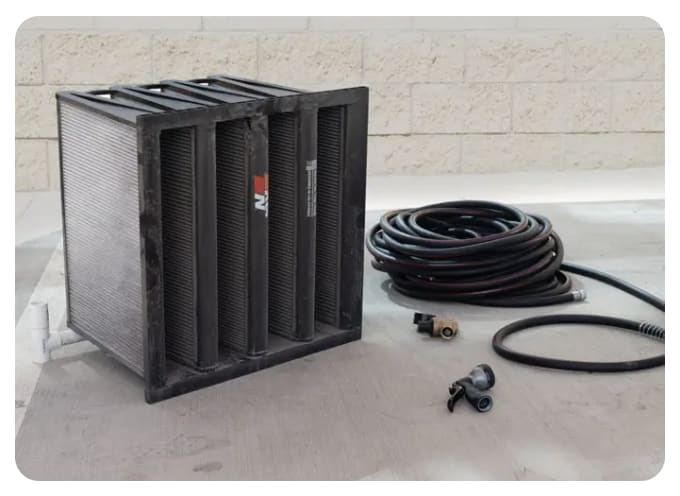
TOOLS NEEDED

  • Cold water supply
  • Pressure regulator set to 40psi
  • Standard garden hose
  • Spray nozzle on “full” setting

  • Riser/Prop for drainage
  • Timer or stopwatch
  • Fan for optional gentle airflow during drying

WATCH THE PANEL WASHING INSTRUCTIONS VIDEO

Maintain your K&N V-Bank Filter with ease—watch the video or use the instructions below.

STEP 01 – PREPARE THE AREA

Choose a clean outdoor space with good drainage for runoff water. Ensure water supply is connected through a pressure regulator set to 40psi.

STEP 02 – ADJUST THE PRESSURE & SPRAY SETTINGS

Regulate water pressure to 40psi.
This avoids filter media damage and maintains optimal cleaning effectiveness.
Do not exceed 40psi.
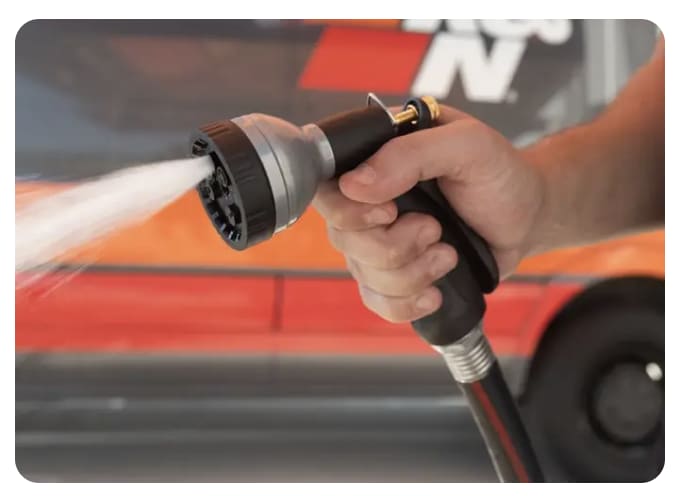
Set the nozzle to the circular “full” setting.
This produces a soft, circular spray ideal for even cleaning.
Avoid jet, stream, or pinpoint settings that may harm filter media.

STEP 03 – PROP-UP FILTER FOR DRAINING

Prop up the filter from the rear with a dowel or PVC to ensure water and debris drain effectively.
Ensure the filter pleats run horizontally.

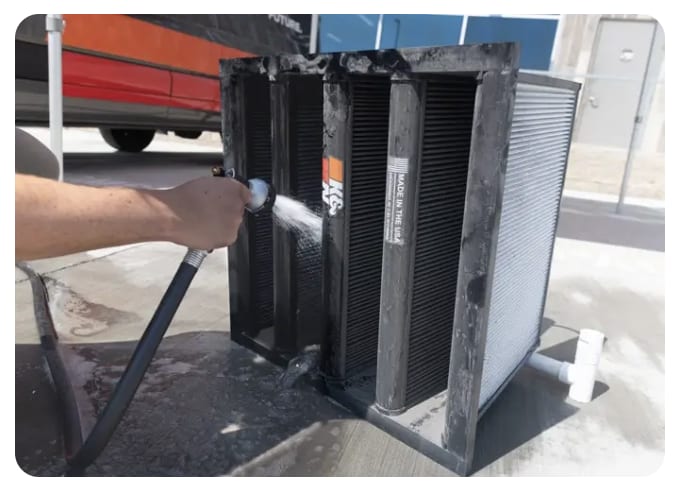
STEP 04 – WASH WITH SLOW, DELIBERATE FLUSHING

Orient the water-stream oblique to the filter media.
With a continuous sweeping motion, flush the filter media water in a parallel to the direction of the pleats.

STEP 05 – GETTING THE FILTER CLEAN

Total wash time: 12 minutes per v-bank filter. Dedicate 90 seconds to each panel within the V-Bank filter. (8 panels × 90 seconds each).

STEP 06 – DRYING

Allow filters to air dry for 12 hours in a clean, indoor location. Maintain ambient humidity and a room temperature between 70–85°F.
Use a gentle fan to circulate air around the filter, but do not use heat or direct airflow into the filter.

AVOID THE FOLLOWING TO PREVENT DAMAGE TO THE FILTER

  • Do not use chemicals or detergents.
  • Do not use a pressure washer.
  • Do not dry using heat guns, ovens, or direct sunlight.
  • Do not use an air gun or compressed air.
  • Do not exceed 40psi.

K&N Washable/Reusable Panel Filter Washing Instructions

K&N Washable/Reusable Panel Filter Washing Instructions

Maintain peak performance and extend the life of your K&N Washable Filters by following the steps below. This procedure is designed for safe, effective cleaning using only water—no chemicals or detergents are required. Always follow K&N’s recommended service intervals. Regular maintenance helps ensure airflow efficiency and optimal performance of your filtration system.

TOOLS NEEDED

  • Cold water supply
  • Pressure regulator set to 40psi
  • Standard garden hose
  • Spray nozzle on “full” setting

  • Riser/Prop for drainage
  • Timer or stopwatch
  • Fan for optional gentle airflow during drying

WATCH THE PANEL WASHING INSTRUCTIONS VIDEO

Maintain your K&N Panel Filter with ease—watch the video or use the instructions below.

STEP 01 – PREPARE THE AREA

Choose a clean outdoor space with good drainage for runoff water. Ensure water supply is connected through a pressure regulator set to 40psi.

STEP 02 – ADJUST THE PRESSURE & SPRAY SETTINGS

Regulate water pressure to 40psi.
This avoids filter media damage and maintains optimal cleaning effectiveness.
Do not exceed 40psi.
Set the nozzle to the circular “full” setting.
This produces a soft, circular spray ideal for even cleaning.
Avoid jet, stream, or pinpoint settings that may harm filter media.

STEP 03 – PROP-UP FILTER FOR DRAINING

Prop up the filter from the rear with a dowel or PVC to ensure water and debris drain effectively.
Ensure the filter pleats run horizontally.

STEP 04 – WASH WITH SLOW, DELIBERATE FLUSHING

Orient the water-stream oblique to the filter media.
With a continuous sweeping motion, flush the filter media water in a parallel to the direction of the pleats.

STEP 05 – GETTING THE FILTER CLEAN

You’ll see dirty water runoff initially transitioning to clear, clean water as the filter becomes clean.
Total wash time: 90 seconds. Dedicate 90 seconds to each Panel filter.

STEP 06 – DRYING

Allow filters to air dry for 12 hours in a clean, indoor location. Maintain ambient humidity and a room temperature between 70–85°F.
Use a gentle fan to circulate air around the filter, but do not use heat or direct airflow into the filter.

AVOID THE FOLLOWING TO PREVENT DAMAGE TO THE FILTER

  • Do not use chemicals or detergents.
  • Do not use a pressure washer.
  • Do not dry using heat guns, ovens, or direct sunlight.
  • Do not use an air gun or compressed air.
  • Do not exceed 40psi.

Green Globes for Existing Buildings Points Guide

Green Globes for Existing Buildings Points Guide

The Materials section 5.2 of GreenGlobes, Recycling and Waste, earns a maximum of 55 points out of a program total of 1,000 points when calculating a green building initiative. Green Globes certification requires a minimum overall score of 35% of the total applicable points, and certified projects are assigned a rating of One to Four Green Globes. A waste diversion policy itself earns six points and must include types of consumables/disposables waste being diverted from landfill, contractor requirements, and waste reduction targets. Waste measurements should be expressed both in absolute terms (e.g. the total amounts of trash and recycling) and percentage rate reduction over a specific timeframe.

Waste diversion target credits are awarded as follows:

Diversion Target PercentagePoints
85% – 100% 5
75% – 84%4
50% – 74% 3
25% – 49% 2
Less than 25% or unknown0

Depending on other waste streams for the building, the use of reusable filters will raise the diversion rates to earn additional points.

To calculate the additional weight of diverted waste by using K&N reusable filters:

  • Before installing K&N filters, weigh a representative sample of legacy disposable filters from each air handling unit (AHU) operated in the building, when they have reached the end of their service life, as they are removed before they are sent to landfill.
  • Multiply the weights of individual used filters by the number of filters installed in each AHU to derive the total weight of filters being sent to landfill for the building.
  • This can be applied to the baseline year to show the percentage rate reduction for the following year and will go towards your waste diversion performance for your Green Globes Assessor to review.

To learn more about the Green Globes for Existing Buildings program, visit thegbi.org/greenglobes.

How a Global Bank Cut $803K in HVAC Costs & Reduced Waste

How a Global Bank Cut $803K in HVAC Costs & Reduced Waste

SUSTAINABILITY LEADERSHIP IN LONDON’S FINANCIAL DISTRICT WITH K&N ENGINEERING REUSABLE HVAC FILTERS

In 2023, a global financial services firm in London’s Financial District replaced its disposable filters with K&N washable, reusable filters across its 10-story headquarters. The facility team, already committed to sustainability with initiatives like a rooftop garden using recycled water, aimed to further that commitment as they participated in a pilot of K&N’s potentially transformative product: high-flowing, washable re-usable HVAC filters.

*Does not include energy performance or waste disposal and removal cost calculation.

By adopting K&N filters, the firm significantly reduced landfill waste, improved energy efficiency, and achieved an ROI in under two years. K&N’s solution not only supported the building’s sustainability goals but also offered long-term cost savings and a measurable environmental impact. The facilities team has now had the filters installed for the full ROI payback period and is continuing to enjoy the benefits of reduced impact to the waste stream, improved energy efficiency and financial savings.

Project

Financial Services Firm EMEA HQ K&N Replaced Legacy Disposables

Location

London, United Kingdom

Use case

City Center High Rise 10-story building with 826,000 net ft² of office space

Equipment

Cooling Towers - 448 units of 12"x12"x2" and 448 of 24"x24"x2" standard MERV 8 panels

The keys to success

The client was able to demonstrate significant improvement in differential pressure while also demonstrating a slowing of the build-up of dP over the legacy disposable filters. Managers were able to extend the changeout cycle from roughly 5 months to washing every 9 months.

Overall the operation is more sustainable, requiring fewer deliveries and fewer waste hauls as a result of the change.

TRANSFORM YOUR FACILITY

FILTERs FOR YOUR PILOT

Air filtration without hesitation. To demonstrate our confidence, K&N Global Filtration will supply filters to jump start a pilot program in your facility. Inquire below and connect with our Product Specialist for more details on the pilot program and how to get started.